
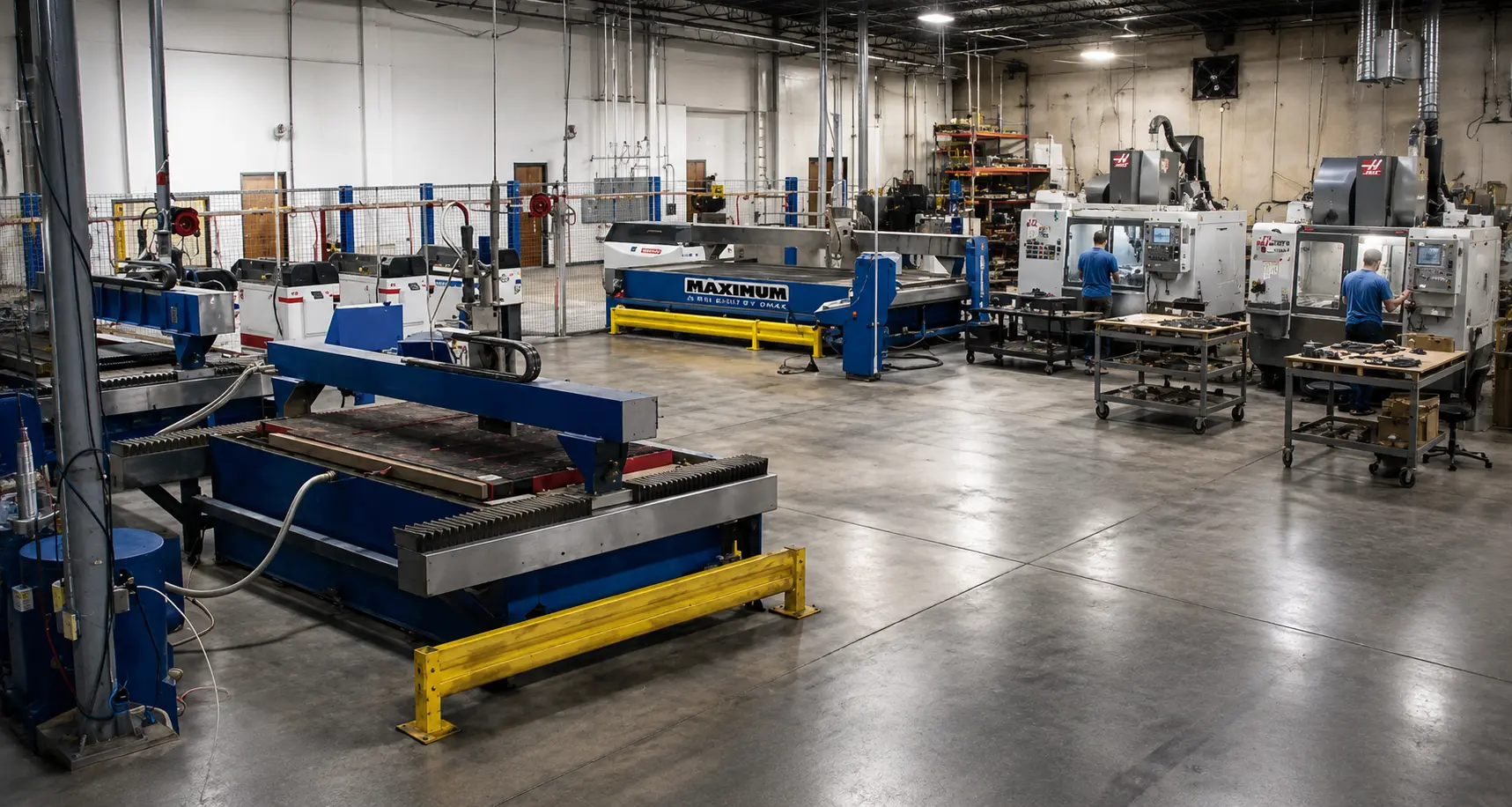
Certified.
Documented.
Repeatable.
AS9100D and ISO 9001 quality systems, CMMC compliance for controlled program work, and a NAS 412 assembly lab. On aerospace and defense programs the part is only half the deliverable — the paperwork behind it is the other half.
The standards that let us take the work.
Certification is not decoration on an aerospace supplier. It is the gate that decides whether a program can buy from you at all. Here is what we hold and what each one actually governs.
AS9100D
The aerospace industry's quality standard, built on ISO 9001 with requirements the general standard does not carry: risk management, configuration control, counterfeit part prevention, product safety, and first article inspection. It is the credential most primes treat as non-negotiable before a purchase order is written.
ISO 9001
The foundation the aerospace standard is built on. Documented processes, corrective and preventive action, internal audit, and management review — the discipline that keeps a good result from being an accident. It governs the commercial and industrial work as much as the aerospace side.
CMMC
The Department of Defense framework governing how contractors protect Federal Contract Information and Controlled Unclassified Information. For defense work it decides whether your drawings and models can legally live on our network at all.
NAS 412
Our assembly lab operates to NAS 412, the aerospace standard for foreign object damage and debris prevention. On flight hardware a loose chip or a stray fastener is not a housekeeping problem, it is a failure mode — so assembly happens in a controlled environment rather than on the open floor.
Caught at the print, not at the packing table.
Inspection at the end of a job only tells you what already went wrong. The controls that matter happen before the first chip is cut.
DFM Review
Design-for-manufacturing support is on site and happens before we quote. If a drawing fights the machine, you hear it then — not after a first article comes back wrong.
First Article
The process gets proved on a single part before it gets trusted with a production run, with dimensional results documented against the print or the model.
In-Process Checks
Verification happens at the machine while the setup is still live, so a drifting feature gets corrected on the spot instead of becoming a scrapped lot.
Final & Documentation
Final dimensional inspection, then the paperwork the program requires — inspection records, material certifications, and part marking applied in-house.
Every number written down.
Model-based definition capable, with the measurement and record-keeping to match. A part that meets print but cannot prove it is not finished.
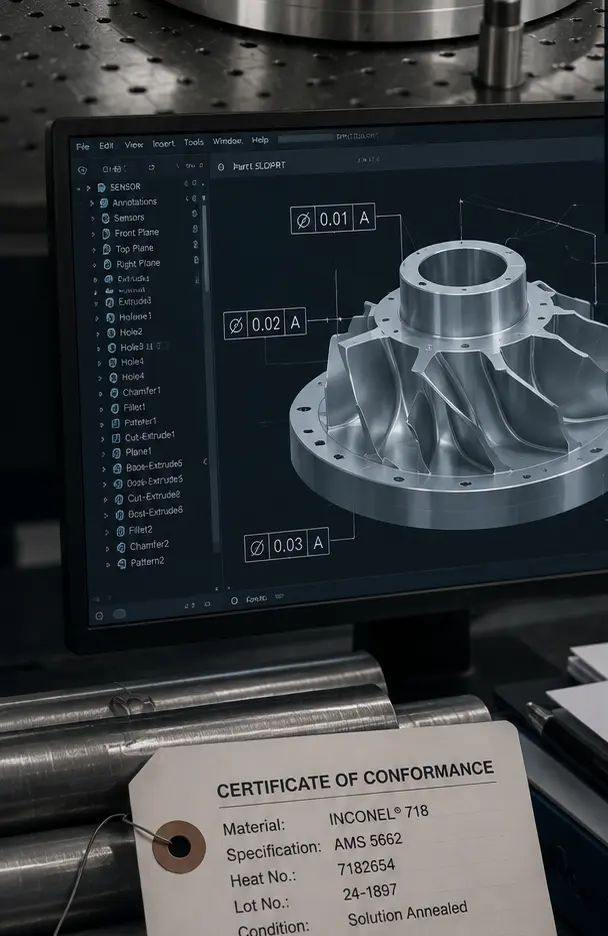
Dimensional Inspection
Close-tolerance verification against print or model — at first article, in process, and at final — with results recorded against the feature they belong to.
Model-Based Definition
We work from the model where the program works from the model, so tolerance and annotation data carry through from engineering to inspection without a translation step.
Material Traceability
Certifications follow the material from receipt through production, which matters on super-alloys where substitution is neither detectable by eye nor survivable in service.
In-House Part Marking
Serial numbers, part numbers, and data matrix codes are laser-marked on the same floor the part was cut and machined on — traceability applied without shipping to a third party.
Calibration Program
Measurement equipment is maintained on a documented calibration schedule, so an inspection result from last quarter stands up to audit the same as one from this morning.
Rigorous quality practices, advanced machining expertise, and responsive collaboration — to deliver components that perform when failure is not an option.
From complex prototypes to production-ready parts, we work closely with our customers to turn demanding requirements, tight tolerances, and mission-critical challenges into dependable results. If your program has a supplier package, a survey, or a source inspection requirement, send it with the RFQ and we will work to it.