
5-Axis Machining
for Aerospace
Titanium, stainless steel, and nickel-based super-alloys machined in a single setup, for parts up to 1,100 lbs and 30″ in height. Complex geometry, held to aerospace expectations, with exceptional surface finish.
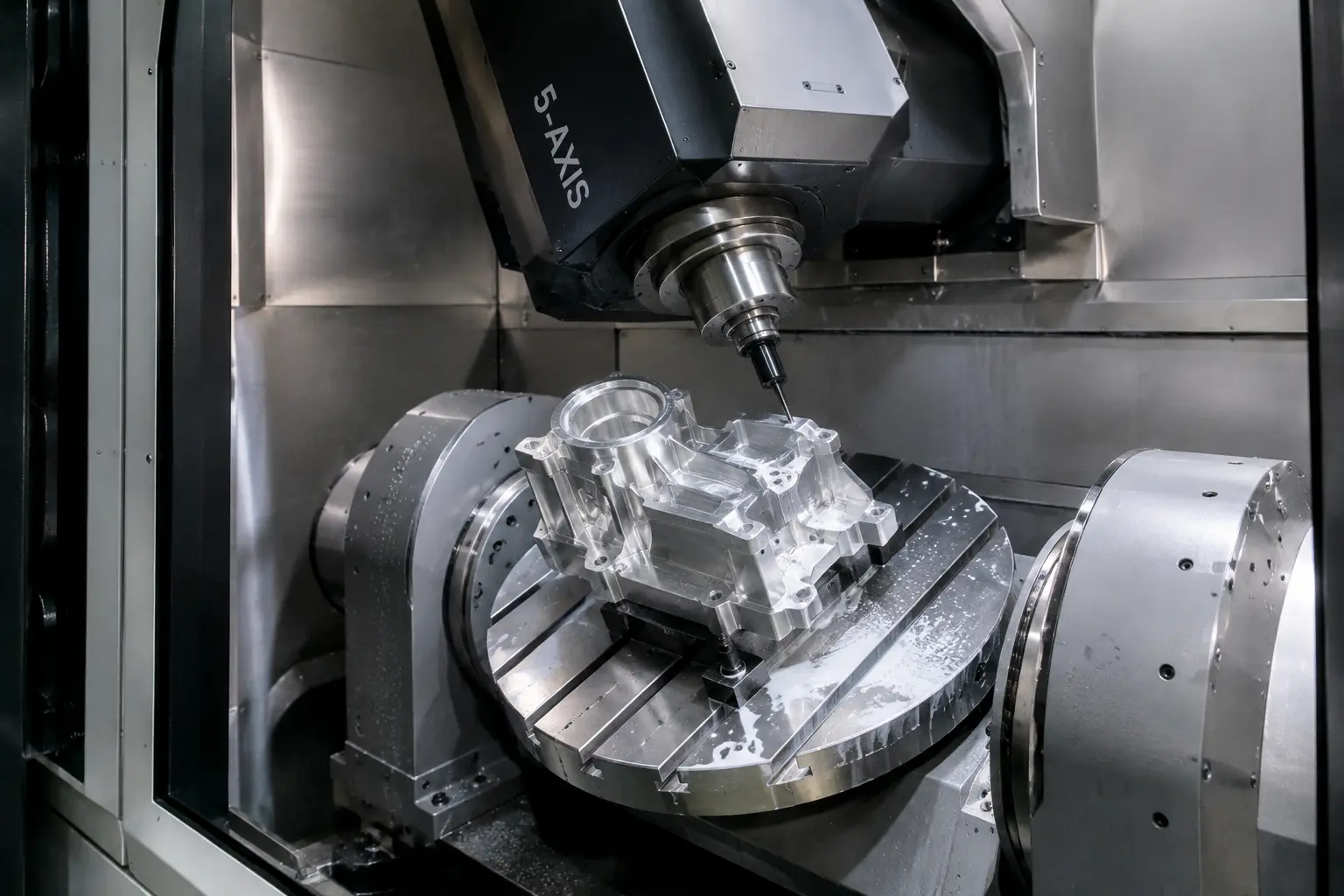
Complex geometry, one setup.
Five-axis machining moves the cutter along three linear axes while the part or head rotates on two more. The practical result is that a feature on the far side of a part can be reached without unclamping it, which is why parts that would take four or five setups on a 3-axis machine can often be finished in one.
Every setup is an opportunity to introduce error. Re-fixturing a part means re-establishing datums, and each of those handoffs stacks tolerance. Holding the part once and letting the machine find the angles removes that stack entirely, which is the real reason aerospace work gravitates toward 5-axis.
We run this capability on titanium, stainless steel, and nickel-based super-alloys for parts up to 1,100 lbs and 30″ in height. It is an aerospace specific capability, and the surface finish coming off these machines reflects that.
Where a job calls for near-net cutting followed by finish machining, both happen in this building. See milling, turning, and routing for the large-envelope 3-axis work, and our quality page for the inspection and documentation behind every part.
5-Axis Capabilities
- Parts up to 1,100 lbs and 30″ in height
- Titanium, stainless steel, and super-alloys
- Complex geometry held in a single setup
- Exceptional surface finish as-machined
- Model based definition capable
- Climate controlled facility for tolerance stability
- CMM, FARO, laser QC, and optical comparator inspection
What is 5-axis machining, and when is it worth it?
Not every part needs it. On the parts that do, the difference shows up in tolerance, finish, and how many weeks the job takes.
Fewer Setups
Multiple faces machined without unclamping the part. Fewer setups means fewer datums to re-establish and fewer chances for error to creep in.
Tighter Stack-Up
Every re-fixturing adds tolerance. Holding the part once keeps feature-to-feature accuracy tied to the machine rather than to how well it was relocated.
Better Surface Finish
Tilting the tool keeps the cutter working at its optimal angle rather than dragging its centreline through the cut, which is what produces the finish these parts need.
Geometry 3-Axis Cannot Reach
Undercuts, compound angles, and contoured surfaces that a 3-axis machine simply cannot approach become ordinary work.
The alloys that punish a machine shop.
Super-alloys are chosen because they hold strength at temperature. That same property is what makes them difficult to cut, and it is where experience separates shops.
Nickel Super-Alloys
The materials common in launch systems and hot section components. They work-harden as you cut them, which punishes the wrong feed and speed immediately.
Titanium
Light, strong, and unforgiving. Titanium holds heat in the cut rather than carrying it away in the chip, so tool path and coolant strategy decide whether the part or the cutter wins.
Stainless Steel
Familiar, but not simple at tight tolerance. Stainless moves as it is cut, which is where a climate controlled shop and disciplined process control earn their keep.
Built for the programs where failure is not an option.
Aerospace
Space Launch
Defense
Unmanned Systems
Industrial & OEM
Have a part that needs five axes?
Send the model and the print. We will confirm the setup approach, the material strategy, and whether 5-axis is genuinely the right call for your part.